


CASE STUDY
BusCharter
BusCharter
29% Conversion Rate and 1,025% ROAS, Built on Offline Data and Hyper-Segmentation
29% Conversion Rate and 1,025% ROAS, Built on Offline Data and Hyper-Segmentation
How Market Lead rebuilt BusCharter's paid acquisition engine around a hyper-segmented account structure and a live offline quote and sales feedback loop, delivering a 29.27% conversion rate, a 10.77% CTR, and a 1,025% return on ad spend across a rolling 90 day window in one of Australia's most competitive transport categories.
How Market Lead rebuilt BusCharter's paid acquisition engine around a hyper-segmented account structure and a live offline quote and sales feedback loop, delivering a 29.27% conversion rate, a 10.77% CTR, and a 1,025% return on ad spend across a rolling 90 day window in one of Australia's most competitive transport categories.
Industry
Industry
Transport, Bus Hire and Charter (B2B and B2C)
Transport, Bus Hire and Charter (B2B and B2C)
Services
Services
Advanced Google Ads, Conversion Rate Optimisations, Meta Ads, Enterprise Reporting, Advanced Data & Attribution
Advanced Google Ads, Conversion Rate Optimisations, Meta Ads, Enterprise Reporting, Advanced Data & Attribution
Timeline
Timeline
Multi-year engagement, current trailing 90 days
Multi-year engagement, current trailing 90 days
Conversion Rate
Conversion Rate
29.27%
Click-Through Rate
Click-Through Rate
10.77%
Return on ad spend
Return on ad spend
1,025%
The Challenge
Challenge
The Challenge
Challenge
The Challenge
Challenge
A Market-Leading Operator in an Increasingly Competitive Category
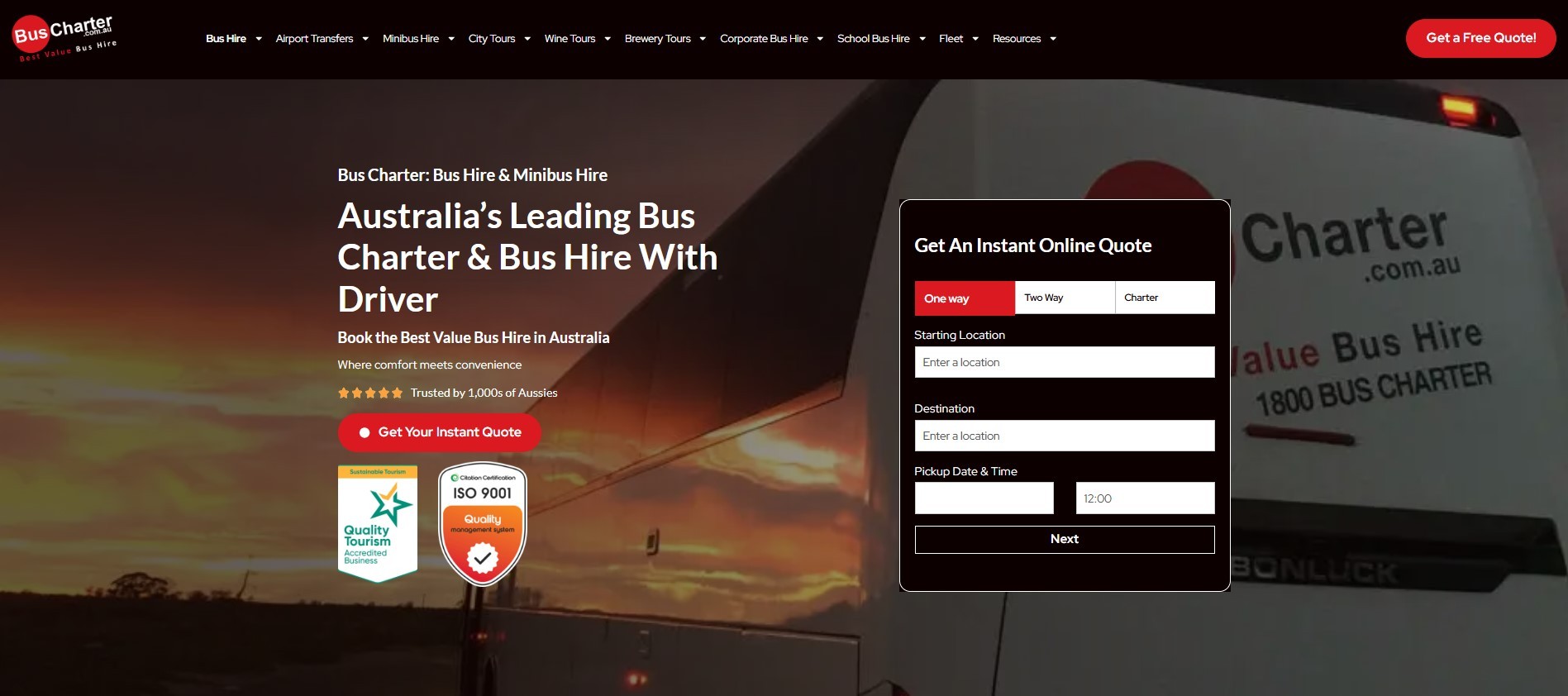
BusCharter is one of Australia's most established bus hire and charter operators, ISO 9001 certified and Quality Tourism accredited, with thousands of customers serviced across Sydney, Melbourne, Brisbane, and the surrounding metros.
BusCharter is one of Australia's most established bus hire and charter operators, ISO 9001 certified and Quality Tourism accredited, with thousands of customers serviced across Sydney, Melbourne, Brisbane, and the surrounding metros.
For years, paid search had been a reliable acquisition engine, supported by a strong brand presence and direct word-of-mouth referral volume.
For years, paid search had been a reliable acquisition engine, supported by a strong brand presence and direct word-of-mouth referral volume.
The category, however, was getting harder. New competitors were entering the space, average CPCs were climbing year on year, and the existing Google Ads account was structured in a way that could not keep up with that pressure. Budget was leaking into low-intent traffic, conversion data was fragmented between online clicks and offline sales, and the leadership team had no consolidated view of which campaigns, cities, or services were actually generating revenue versus simply generating activity.
The category, however, was getting harder. New competitors were entering the space, average CPCs were climbing year on year, and the existing Google Ads account was structured in a way that could not keep up with that pressure. Budget was leaking into low-intent traffic, conversion data was fragmented between online clicks and offline sales, and the leadership team had no consolidated view of which campaigns, cities, or services were actually generating revenue versus simply generating activity.
Fragmented online and offline attribution, no consolidated reporting, increasing category CPC pressure
Fragmented online and offline attribution, no consolidated reporting, increasing category CPC pressure
Our Approach
Approach
Our Approach
Approach
Our Approach
Approach
Rebuild the Engine Around the Customer, Not the Channel
Structure the account around how customers actually buy bus charter services, not how Google Ads defaults the data. Customers buy by city, by service tier, and by booking moment, and the account had to mirror that.
The guiding principle was simple: structure the account around how customers actually buy bus charter services, not how Google Ads defaults the data. Customers buy by city, by service tier (minibus vs coach, CBD vs regional), and by booking moment (mobile-first, time-of-day sensitive, often seasonal). The account had to mirror that.
Structure the account around how customers actually buy bus charter services, not how Google Ads defaults the data. Customers buy by city, by service tier, and by booking moment, and the account had to mirror that.
The guiding principle was simple: structure the account around how customers actually buy bus charter services, not how Google Ads defaults the data. Customers buy by city, by service tier (minibus vs coach, CBD vs regional), and by booking moment (mobile-first, time-of-day sensitive, often seasonal). The account had to mirror that.
The Key Insight
In a category where competition was driving every other operator's cost per click higher, the only durable advantage was structural. Hyper-segmentation by city, by service, by device, and by booking moment produced more conversions per dollar than any single bid adjustment ever could.


Execution
Execution
Execution
Execution
Execution
Execution
Four Pillars That Transformed the Pipeline
Google Ads
• Hyper-segmented by city, service tier, and device so budget allocates based on what each segment actually returns.
• Brand campaign defending owned demand while location and service campaigns capture net-new market.
• Bids tuned to quote-stage and sale-stage conversion data, not click volume.
• Device splits where intent and conversion behaviour differ materially, each bid on its own merits.
Google Ads
• Hyper-segmented by city, service tier, and device so budget allocates based on what each segment actually returns.
• Brand campaign defending owned demand while location and service campaigns capture net-new market.
• Bids tuned to quote-stage and sale-stage conversion data, not click volume.
• Device splits where intent and conversion behaviour differ materially, each bid on its own merits.
Meta Ads
• Segmented architecture running direct response to new audiences and brand trust to returning visitors.
• Creative split testing across charter occasions (corporate, school, tourism, events) to identify the highest-converting booking moments.
Meta Ads
• Segmented architecture running direct response to new audiences and brand trust to returning visitors.
• Creative split testing across charter occasions (corporate, school, tourism, events) to identify the highest-converting booking moments.
Data & Attribution
• Offline quote and sales data fed back into Google Ads so algorithms optimise toward real bookings, not just form fills.
• Integrated call tracking crediting phone-driven bookings correctly to source.
• Single dashboard consolidating Google Ads, Meta, SEO, and website behaviour with flexible reporting periods.
• Monthly reviews structured around the same segments as the ad account: city, service, and device.
Data & Attribution
• Offline quote and sales data fed back into Google Ads so algorithms optimise toward real bookings, not just form fills.
• Integrated call tracking crediting phone-driven bookings correctly to source.
• Single dashboard consolidating Google Ads, Meta, SEO, and website behaviour with flexible reporting periods.
• Monthly reviews structured around the same segments as the ad account: city, service, and device.
The Outcome
Outcome
The Outcome
Outcome
The Outcome
Outcome
A Compounding Engine That Pays for Itself Many Times Over
Over a rolling 90 day window, the rebuilt account is producing a 29.27% conversion rate against a 10.77% click-through rate, at a $4.36 average cost per click in a category where competitive pressure has pushed industry averages well above that.
The clearest signal that the structure is working sits in the attribution data: a 1,025% return on ad spend across a rolling 90 day window, traced through to actual quotes and bookings via the offline data feedback loop, not just through-the-click conversions. That figure is not a forecast or a model. It is the direct, sales-team-confirmed outcome of running the account on a structure that mirrors how the business actually sells.
The reporting layer ties it all together. The owner and general manager now have one view that shows what is being spent, where it is being spent, what is being converted, and what is being booked, with the same hyper-segmented shape as the underlying campaigns. That is what makes the engine durable.
Over a rolling 90 day window, the rebuilt account is producing a 29.27% conversion rate against a 10.77% click-through rate, at a $4.36 average cost per click in a category where competitive pressure has pushed industry averages well above that.
The clearest signal that the structure is working sits in the attribution data: a 1,025% return on ad spend across a rolling 90 day window, traced through to actual quotes and bookings via the offline data feedback loop, not just through-the-click conversions. That figure is not a forecast or a model. It is the direct, sales-team-confirmed outcome of running the account on a structure that mirrors how the business actually sells.
The reporting layer ties it all together. The owner and general manager now have one view that shows what is being spent, where it is being spent, what is being converted, and what is being booked, with the same hyper-segmented shape as the underlying campaigns. That is what makes the engine durable.

Ready to Build Your Own Engine?
We've helped operators like BusCharter restructure their entire paid acquisition engine and tie it back to real revenue. If you're running paid traffic in a competitive category and feel like your account structure is the ceiling on your growth, let's talk.
© 2026 Market Lead Pty Ltd. All rights reserved.